
Safe breast lift techniques achieve a youthful contour while prioritizing patient well-being. A successful mastopexy results from meticulous planning, surgical precision, and evidence-based methods, ensuring predictable, natural, and lasting outcomes.
Safe Breast Lift Techniques: Ensuring Optimal Patient Outcomes
Safe breast lift techniques are paramount for achieving youthful breast contours while prioritizing patient well-being. This article emphasizes that successful mastopexy relies on meticulous planning, surgical precision, and evidence-based methods. Adhering to proven surgical best practices, including careful tissue preservation and maintaining blood supply, is crucial for mastopexy safety. These established protocols minimize complications, such as poor scarring or asymmetry, leading to predictable, natural, and lasting patient outcomes.
Mr. Roshan Vijayan, a board-certified Consultant Plastic Surgeon, prioritizes safe, tried, and tested surgical techniques. His expertise ensures natural, balanced, and well-proportioned aesthetic results, reflecting a commitment to patient safety and satisfaction.
To explore your options, contact us to schedule your consultation. You can also reach us via: Request a Callback
Safe breast lift techniques achieve a youthful contour while prioritizing patient well-being. A successful mastopexy, or breast lift, results from meticulous planning, surgical precision, and evidence-based methods. Mastopexy safety depends on the surgeon's qualifications and surgical practices that ensure predictable, natural, and lasting outcomes.
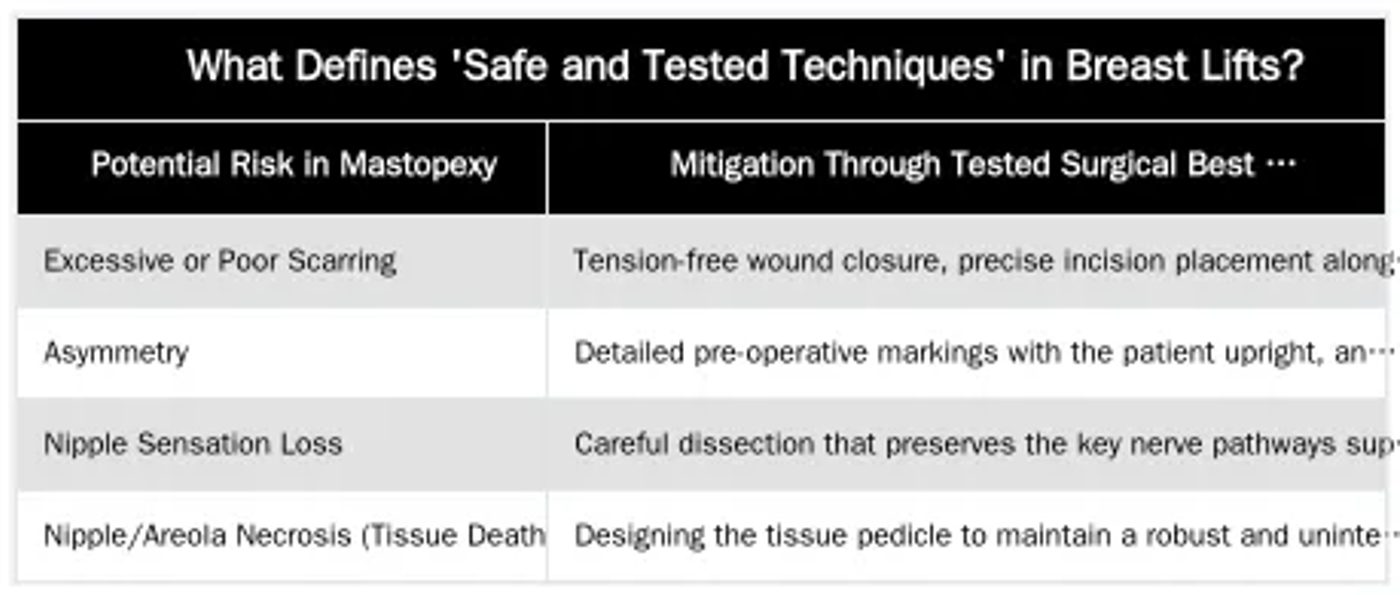
What Defines 'Safe and Tested Techniques' in Breast Lifts?
In plastic surgery, 'safe and tested techniques' are surgical methods evaluated through clinical practice, peer-reviewed academic research, and long-term patient follow-up. These established procedures produce consistent results while minimizing complications. They ensure each step of a breast lift procedure is based on an understanding of human anatomy and healing.
The Foundation of Evidence-Based Plastic Surgery
A technique is 'tested' when supported by evidence, including validation through clinical trials and publication in peer-reviewed medical journals. This process confirms the procedure's efficacy and safety profile. For patients, this means the surgical approach works predictably, becoming a standard of care. This evidence-based approach is central to modern plastic surgery, as outlined in The Complete Guide to Aesthetic Breast Surgery in the UK.
Why Are Proven Surgical Methods Crucial for Mastopexy Safety?
Adhering to established surgical methods is critical for patient safety during a mastopexy. These practices preserve blood supply to the nipple and surrounding tissues and use tension-free incision closure to promote healing. Following these protocols reduces adverse events and leads to predictable, successful outcomes.
Minimizing Risks and Preventing Complications
Proven techniques mitigate the inherent risks of surgery. Each step, from pre-operative planning to the final suture, is calculated to prevent issues like infection, poor scarring, or asymmetry. Modern approaches have improved safety profiles over older techniques.
Ensuring Natural, Balanced, and Lasting Outcomes
A breast lift's goal is a natural, aesthetically pleasing, and lasting shape. Safe techniques achieve this by respecting the breast's underlying structure. Preserving tissue viability and ensuring a strong blood supply promotes better healing and tissue integration. This focus on structural integrity helps maintain the lift's results, preventing premature sagging and ensuring a balanced contour.
The Surgeon's Role: Expertise and Best Practices for a Safe Breast Lift
A technique's effectiveness depends on the surgeon's skill and judgment. A surgeon's qualifications, experience, and commitment to best practices are key to a safe and successful breast lift. This expertise ensures the chosen technique matches the patient's anatomy and aesthetic goals.
The Value of a Board-Certified Consultant Plastic Surgeon (FRCS(Plast))
In the UK, the qualification FRCS(Plast) signifies the highest standard of training in plastic surgery. It indicates completion of a multi-year training programme and comprehensive examinations covering all aspects of plastic, reconstructive, and aesthetic surgery. As detailed by the Royal College of Surgeons of England, this qualification is a hallmark of technical excellence and a commitment to patient safety. Surgeons with this qualification, like Mr. Roshan Vijayan, are on the GMC Specialist Register for Plastic Surgery, providing patients verifiable assurance of their expertise.
Meticulous Pre-Operative Planning and Patient Selection
A safe procedure begins with a thorough pre-operative assessment. This involves reviewing the patient's medical history, examining breast tissue and skin quality, and discussing realistic expectations. This planning allows the surgeon to identify potential risk factors and select the most appropriate surgical plan, ensuring the patient is a suitable candidate who understands the process.
Advanced Techniques for Enhanced Safety and Superior Results
Plastic surgery is evolving with refinements that improve safety and outcomes. Modern mastopexy uses advanced methods for better support, reduced incision strain, and longer-lasting results. These are enhancements built upon proven, safe practices.
Innovations in Suture Methods and Tissue Preservation
Modern breast lifting emphasizes internal support structures. Instead of relying on skin tension, surgeons use multi-layered suturing techniques to anchor and reshape underlying breast tissue. This method reduces tension on the external skin closure, leading to finer, less noticeable scars. As detailed in this overview of mastopexy techniques explained, preserving healthy breast tissue and its blood supply is paramount for a natural-feeling result.
Understanding the 'Internal Bra' Technique and Its Safety Benefits
The "internal bra" technique uses the patient's own lower breast tissue or specialized sutures to create an internal support scaffold. This internal sling holds the breast tissue in its newly elevated position. By providing this structural reinforcement, the technique reduces the forces of gravity and tension on the skin. This creates a more stable and durable lift and enhances safety by minimizing the risk of suture lines widening or the breast shape descending over time.
Navigating Risks: How to Minimize Complications in Breast Lift Surgery
Understanding potential complications is essential for making an informed decision. While a qualified surgeon using proven methods lowers these risks, patient awareness and compliance with after-care instructions are vital for a safe recovery.
Proactive Strategies for Complication Prevention
Complication prevention is a collaborative effort. It begins with the surgeon's technique in a sterile environment and extends to the patient's adherence to after-care instructions, which are designed to prevent issues like infection and poor wound healing. Following guidance on wound care, activity restrictions, and wearing support garments is an integral part of the safety protocol. A guide to breast lift complications and risks can provide further detail.
Patient Responsibilities and Post-Operative Care
The patient's role in a safe outcome is crucial. This includes providing a complete medical history, stopping smoking well before surgery, and arranging for support during recovery. After the procedure, following all post-operative instructions—from taking prescribed medications to attending follow-up appointments—is essential for monitoring healing and addressing any concerns promptly.
Achieving Your Aesthetic Goals with Confidence and Safety
Prioritizing surgeons who use safe and tested techniques allows patients to proceed with confidence, knowing their health is the primary focus. This approach ensures an aesthetic result is achieved with the lowest possible risk, leading to patient satisfaction and long-term success.
The Vijayan.co.uk Commitment to Patient Safety and Excellence
Mr. Roshan Vijayan's practice delivers natural, balanced, and well-proportioned aesthetic outcomes using safe, tested surgical techniques. The patient journey, from the initial consultation in Hertfordshire or London to the after-care plan, is designed for clarity, comfort, and safety. This patient-centric approach ensures aesthetic goals are met with the highest standards of surgical care.
Ready to Discuss Your Breast Lift Journey?
If you are considering a breast lift, a personal consultation is the next step to understand how proven surgical methods can help you achieve your goals safely. An in-depth discussion is the best way to receive advice tailored to your anatomy and desired outcome.
Schedule Your Personal Consultation Today
To discuss your individual needs with Mr. Roshan Vijayan and develop a plan centered on effective and safe breast lift techniques, please contact us to schedule your appointment. You can also Request a Callback, and a member of our team will be in touch.
Frequently Asked Questions
What defines 'safe and tested techniques' in a breast lift?
Safe and tested techniques are surgical methods evaluated through extensive clinical practice and research to prove their reliability and low complication rates. These evidence-based approaches are fundamental to a successful mastopexy, ensuring the procedure is predictable and prioritises patient well-being. Employing these proven methods is a cornerstone of safe breast lift techniques.
How does a surgeon's choice of method impact the procedure?
A surgeon's technique is critical for safety, influencing everything from preserving blood supply to the nipple to minimising scarring and preventing infection. Mr. Vijayan's expertise in applying proven methods, like specific incision patterns and internal support sutures, is fundamental to a safe and successful outcome. This careful selection is a key part of providing safe breast lift techniques.
What are some examples of proven mastopexy techniques you use?
The specific technique is always tailored to the patient's unique anatomy and aesthetic goals. Common methods include the vertical (lollipop) or anchor incision mastopexy, which are chosen for their predictable results and safety profiles. In some cases, advanced methods like the internal bra technique may be used to provide long-lasting support and shape, enhancing the efficacy of the procedure.
Why is the initial consultation so important for ensuring safe breast lift techniques are used?
The consultation is vital for planning a safe procedure. It involves a thorough assessment of your health, a detailed discussion of risks and benefits, and setting realistic expectations. This process ensures you are a suitable candidate and that the chosen surgical plan, incorporating safe breast lift techniques, is perfectly tailored to your specific circumstances.
How does Mr. Vijayan stay current with the latest advancements in breast lift surgery?
As a Fellow of the Royal College of Surgeons, Mr. Vijayan is committed to continuous professional development. This involves regularly reviewing academic literature, attending national and international conferences, and participating in the surgical community. This dedication ensures his practice always incorporates the most current and safest methods available for breast lift surgery.
How can I learn more about safe breast lift techniques for my situation?
The best way to understand your options is through a personal consultation with a qualified consultant plastic surgeon. Mr. Vijayan will assess your individual needs, discuss your goals, and explain which surgical approaches are most appropriate for you. You can request a callback to schedule your initial appointment and begin your journey.