

Tummy Tuck (Abdominoplasty)
A tummy tuck (abdominoplasty) removes loose abdominal skin and reshapes the area when pregnancy, weight loss or changes over time have left tissue that cannot be improved through exercise alone. Abdominoplasty can also repair weakened or separated abdominal muscles when this forms part of the surgical plan.
- A smoother, flatter abdominal contour
- Excess, redundant skin removed
- Tightened, better-supported abdominal muscles
- Consultant-led care, with two-surgeon safety on more lengthy cases
What our patients say

This content has been medically reviewed by Mr Roshan Vijayan (GMC Number 7020524) MBBS, BSc (Imperial College London), MRCS (Eng), FRCS (Plast), Executive MBA.
The procedure is tailored to the location and extent of the concern. Some people need a relatively limited correction below the belly button, while others require treatment across the abdomen and flanks. Mr Roshan Vijayan assesses the skin, underlying abdominal wall and overall body proportions before recommending the appropriate approach.
 Tummy Tuck (Abdominoplasty)
The incision is positioned low on the abdomen, where the scar can sit beneath underwear or swimwear.
What Is a Tummy Tuck?
A tummy tuck is an operation that removes excess skin and selected areas of fat from the abdomen. The remaining skin is repositioned to create a firmer contour, while the abdominal wall can be tightened when the muscles have stretched or separated.
The incision is generally positioned low on the abdomen so that the resulting scar can be concealed beneath underwear or swimwear. A full abdominoplasty also involves repositioning the belly button, while a smaller procedure may leave it undisturbed. The NHS guide to tummy tuck (abdominoplasty) surgery sets out what the operation involves and what to consider before going ahead.
Tummy Tuck (Abdominoplasty) at a glance
A quick snapshot of what to expect. Every plan is individual, so Mr Vijayan confirms your own timings at your consultation.
Surgery time
2–5 hours
Time off work
2–3 weeks
Hospital stay
1–2 nights
Showering
After 2 days
Light activity
After 2 weeks
Compression garment
4–6 weeks
Exercise
After 4–6 weeks
Driving
After 2–3 weeks
Full recovery
Up to 6 weeks
Final results
3–6 months
What Can Tummy Tuck Surgery Address?
Abdominal changes can extend beyond a small area of unwanted fat. Skin may have lost its ability to contract after pregnancy or substantial weight loss, while muscle separation can affect the shape and support of the abdominal wall.
Tummy tuck surgery can address:
- Loose or hanging abdominal skin
- Skin folds following substantial weight loss
- Stretched skin after pregnancy
- Weakness or separation of the abdominal muscles (diastasis recti, also known as rectus diastasis)
- Localised fat treated as part of the wider procedure
- Reduced definition between the abdomen and waist
- Irritation or discomfort caused by redundant skin folds
 Benefits
Greater comfort in fitted clothing is among the changes most often noticed once the contour settles.
Key Benefits of Tummy Tuck Surgery
Abdominoplasty changes the abdominal contour by removing tissue that cannot be tightened through diet or exercise. The extent of improvement depends on the original concern and the scale of surgery required.
The procedure can provide:
- Removal of loose and redundant abdominal skin
- A firmer and smoother abdominal contour
- Repair of weakened or separated muscles where required
- Reduced rubbing and irritation from skin folds
- Better definition through the abdomen and waist
- Greater comfort in fitted clothing, underwear and swimwear
- Long-lasting improvement when body weight remains stable
 Is It Right for You?
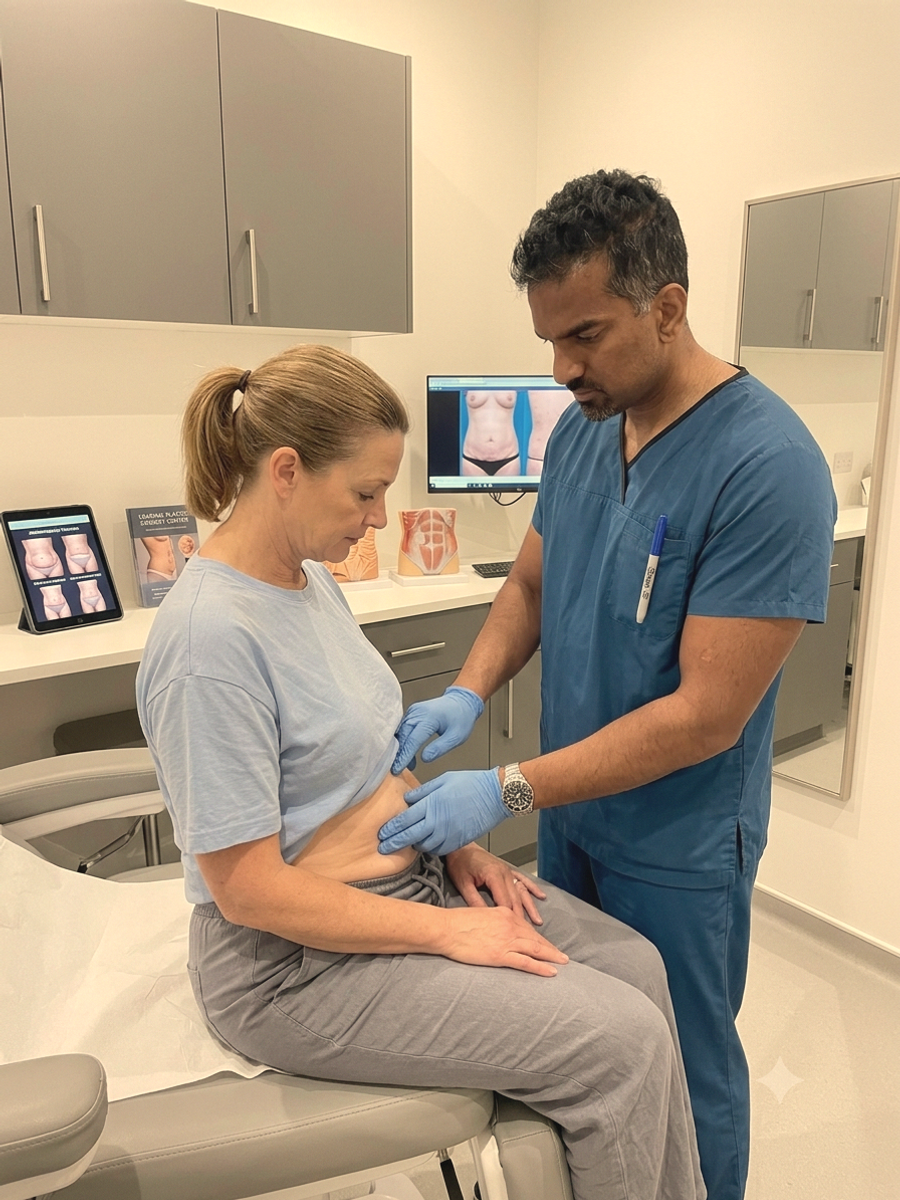
An abdominal assessment considers skin laxity, fat distribution, muscle separation and overall body proportions.
Am I a Suitable Candidate for a Tummy Tuck?
A tummy tuck is suited to people in good general health who have loose abdominal skin, abdominal wall weakness or a combination of concerns that cannot be corrected through lifestyle changes alone. Suitable candidates are generally at or close to a stable weight and understand that the procedure is intended for body contouring rather than weight loss.
Future weight changes and pregnancy can stretch the tissues again, so the timing of surgery should be considered carefully. Smoking also increases the risk of wound-healing problems and must be discussed during assessment. If surgery would present an unnecessary risk or is unlikely to achieve the intended change, Mr Vijayan will explain this clearly.
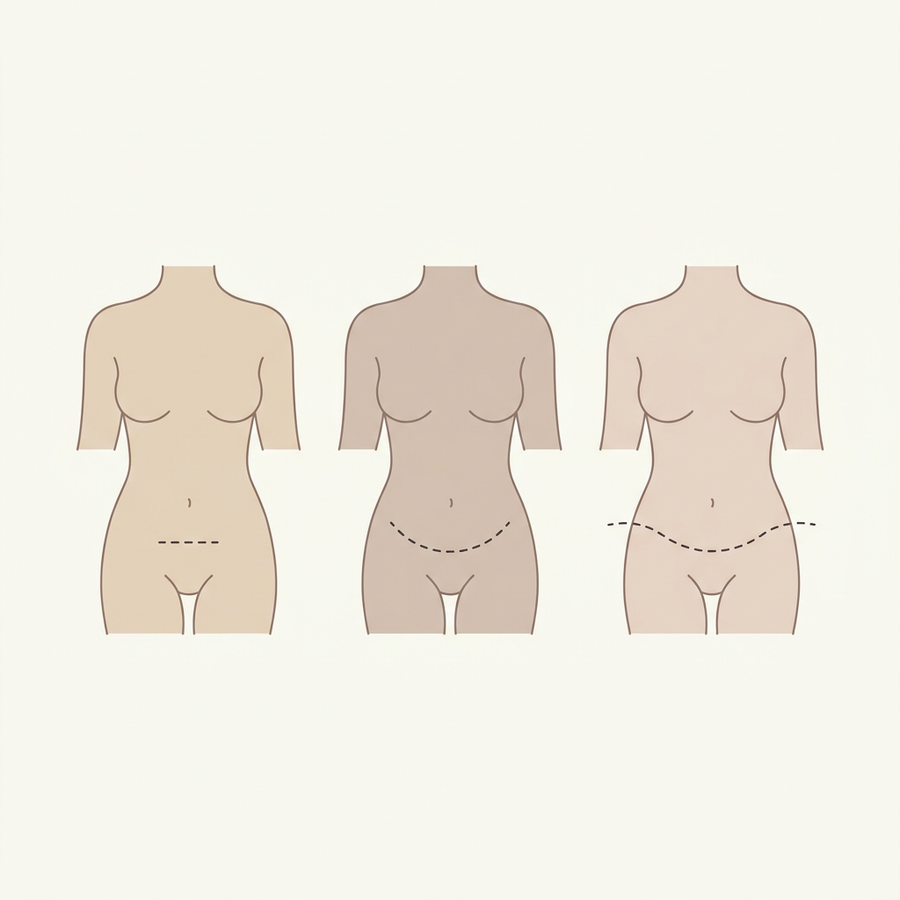
Full, mini and extended abdominoplasty address different locations and amounts of excess abdominal tissue.
Types of Abdominoplasty
The appropriate type of abdominoplasty depends on the location of the excess tissue, the condition of the abdominal wall and how far the correction needs to extend. These factors are assessed during consultation before a surgical technique is recommended.
Full Abdominoplasty
A full abdominoplasty treats loose skin across the upper and lower abdomen. It generally requires an incision from hip to hip, together with an incision around the belly button, so it can be brought through the repositioned skin. The abdominal wall can also be repaired when required.
Mini Abdominoplasty
A mini abdominoplasty focuses on a smaller amount of excess skin and fat below the belly button. It uses a shorter incision and does not generally require the belly button to be repositioned, although its suitability is limited to concerns affecting the lower abdomen.
Extended Abdominoplasty
An extended abdominoplasty continues beyond the front of the abdomen to remove loose skin around the flanks. It is particularly relevant after major weight loss, when redundant tissue extends further around the body than a standard tummy tuck can adequately address.
Fleur-de-Lis Abdominoplasty
A fleur-de-lis abdominoplasty adds a vertical incision to the standard horizontal incision, allowing excess skin to be removed from the upper abdomen as well as the lower abdomen and flanks. It is particularly relevant for patients whose skin laxity extends upward after major weight loss, where a standard or extended abdominoplasty alone would not address the upper abdominal skin.

What Does Tummy Tuck Surgery Involve?
Abdominoplasty is performed under general anaesthesia and generally takes between two and five hours. The operating time depends on whether a mini, full or extended procedure is undertaken and whether abdominal wall repair or additional contouring is included.
A low abdominal incision allows Mr Vijayan to separate and reposition the skin, remove the planned amount of excess tissue and tighten the abdominal wall where required. During a full tummy tuck, the belly button is carefully repositioned before the incisions are closed and dressings are applied.
Your Tummy Tuck Treatment Journey
Tummy tuck surgery requires careful preparation and a realistic understanding of the recovery involved. The process begins with a detailed assessment and continues through personally conducted postoperative reviews.
Your Tummy Tuck Consultation
During your consultation, Mr Vijayan will listen to your concerns, review your medical history and examine the distribution of loose skin, fat and abdominal wall weakness. He will discuss the appropriate type of abdominoplasty, likely scar position, recovery, limitations and possible risks, with clinical photographs taken for planning. You will receive a written summary and can return for a second consultation no sooner than two weeks later before deciding whether to proceed.
The Tummy Tuck Procedure
Surgery is carried out under general anaesthesia using the incision pattern agreed during planning. Excess skin and selected fat are removed, the abdominal wall is tightened when indicated, and the remaining skin is redraped to create a smoother contour. Sutures, dressings and a compression garment are used to support the treated area during early healing.
Tummy Tuck Recovery and Aftercare
Swelling, bruising, tightness and discomfort are expected during the initial recovery period. Light activity can gradually resume as healing progresses, but strenuous exercise and heavy lifting should be avoided for approximately four to six weeks. Mr Vijayan checks in personally after surgery and generally reviews healing at one to two weeks, around six weeks and again at approximately three months, with additional support available if concerns arise.
Tummy Tuck Results
An initial change in abdominal contour is visible after surgery, although swelling means the final result cannot be assessed immediately. The tissues continue to soften and settle over several months, while the scars gradually become less prominent. Results are long-lasting, but pregnancy, substantial weight changes and the natural ageing process can alter the abdomen again.
Recovery and Aftercare
The recovery process from abdominoplasty can take several weeks. Patients are generally advised to avoid strenuous activities for 4 to 6 weeks and wear a compression garment to support healing and reduce swelling. It is common to experience discomfort, swelling, and bruising during the initial recovery period, but these symptoms will gradually subside.
The first few days
You will be supported in a compression garment. Discomfort, swelling and bruising are normal and are managed with prescribed medication. Keeping the surgical site clean matters from the outset.
Week one to two
Most patients return to light activities after around two weeks. Gentle movement little and often is encouraged, while anything strenuous is avoided.
Weeks three to six
The compression garment continues to support healing and reduce swelling. Strenuous activity and heavy lifting are avoided for four to six weeks.
Six weeks onward
Most normal activity, including exercise, is comfortably resumed. Swelling continues to settle and the abdominal contour refines.
Three to six months
Full results appear as the body heals and swelling reduces. Scars soften and fade, and follow-up appointments continue for as long as you need them.
Possible Risks and Complications of a Tummy Tuck
All surgery carries risks, although their relevance and likelihood differ between patients. Mr Vijayan will explain the potential complications during consultation, including how your health and the extent of the proposed surgery affect them, so that you have a clear understanding before deciding whether to proceed.
Risks associated with abdominoplasty include:
- Bleeding, infection or fluid collection (seroma)
- Delayed or uneven wound healing
- Prominent or widened scarring
- Changes in abdominal sensation
- Asymmetry or contour irregularity
- Blood clots (deep vein thrombosis) or complications associated with anaesthesia
Your safety is paramount. Consultant-led aftercare, a day-one call and unlimited follow-up mean any concern is seen and addressed by Mr Vijayan personally.
Why Choose Mr Roshan Vijayan for Tummy Tuck Surgery?
Mr Vijayan is a Consultant Plastic Surgeon with a particular interest in body contouring after pregnancy and substantial weight loss. He approaches abdominoplasty as both a reconstructive and aesthetic procedure, considering physical comfort, tissue support, body proportions and the abdominal contour together.
His approach includes:
Detailed assessment of the skin, abdominal wall and surrounding contours
A surgical plan based on your anatomy and the extent of correction required
Honest guidance about suitability, limitations and achievable results
A second consultation before surgery, allowing time for further questions
Personally conducted postoperative reviews and direct support during recovery
A focus on established surgical methods and balanced proportions


Meet Mr Roshan Vijayan
Mr Roshan Vijayan is a GMC-registered Consultant Plastic Surgeon and Fellow of the Royal College of Surgeons, holding the specialist FRCS(Plast) qualification. After graduating from Imperial College London, he completed extensive plastic surgery training across leading London and South East teaching hospitals before taking up his NHS Consultant post.
He has a particular interest in body contouring after pregnancy and substantial weight loss. His approach to abdominoplasty combines careful technical planning with an understanding of abdominal function, body proportions and the importance of clear, personally led aftercare.
How Much Does a Tummy Tuck Cost?
The cost of a tummy tuck in the UK typically ranges from around £6,000 to £10,000, depending on the type of abdominoplasty, the extent of the correction, and the hospital and anaesthetic requirements. For a full breakdown of what influences pricing and the financing options available, see our complete guide to tummy tuck cost, pricing and financing.
Following your assessment, you will receive a complete quotation explaining the costs associated with your surgical plan before deciding whether to proceed.
Your exact, all-inclusive quote is confirmed in writing after your consultation, with no hidden costs.
Request your personalised quoteFrequently Asked Questions About Tummy Tuck Surgery
Will a tummy tuck help me lose weight?
A tummy tuck is not a weight-loss operation. It removes excess skin and a limited amount of fat to improve abdominal contour, so it is best considered once you have reached a weight you can maintain.
Can a tummy tuck repair separated abdominal muscles?
Yes, weakened or separated abdominal muscles can be brought together when abdominal wall repair is appropriate. Mr Vijayan will assess this during your consultation and explain whether it needs to form part of your procedure.
Will I have a scar after a tummy tuck?
Yes, abdominoplasty leaves a scar across the lower abdomen, with an additional scar around the belly button after a full procedure. Its length depends on the amount of skin removed, but the incision is positioned as discreetly as the anatomy allows.
Can tummy tuck surgery be combined with liposuction?
Liposuction can be combined with a tummy tuck when removing selected areas of fat will improve the overall contour. It cannot replace the skin removal or abdominal wall repair performed during abdominoplasty, and the suitability of combined surgery must be assessed individually.
Can I become pregnant after abdominoplasty?
Pregnancy remains possible after a tummy tuck, but it can stretch the repaired abdominal wall and skin again. If you are actively planning another pregnancy, postponing surgery will generally provide a more stable long-term result.
Is a tummy tuck available on the NHS?
NHS-funded abdominoplasty is limited and is generally considered only when there is a clear clinical need rather than a solely cosmetic concern. Eligibility depends on local commissioning criteria and varies between different areas.
When can I drive after tummy tuck surgery?
You should not drive until you can sit comfortably, move freely, wear a seat belt and perform an emergency stop without hesitation. You must also be free from medication that affects alertness, and you should check any requirements set by your insurer.
How should I sleep after a tummy tuck?
Sleeping on your back with the upper body and knees slightly supported can reduce tension across the incision during early healing. You should avoid sleeping on your stomach until the tissues have recovered sufficiently.
Are tummy tuck results permanent?
Tummy tuck results can remain stable for many years, particularly when you maintain a consistent weight and healthy lifestyle. Pregnancy, substantial weight changes and ageing can still stretch the remaining skin and alter the abdominal contour.
Can men have tummy tuck surgery?
Yes, abdominoplasty is suitable for men with loose abdominal skin or abdominal wall weakness, particularly after substantial weight loss. The incision and contouring plan are adapted to the individual anatomy and distribution of excess tissue.

Book Your Tummy Tuck Consultation
If loose abdominal skin or changes following pregnancy or weight loss are causing concern, a consultation can determine whether tummy tuck surgery is appropriate. Mr Vijayan will assess the abdominal skin and underlying muscles, explain the available surgical approaches and discuss the likely recovery and results. Please arrange a tummy tuck consultation with Mr Vijayan to discuss your options.
Request a Consultation