
Breast asymmetry surgery offers solutions for individuals with uneven breasts, creating a more balanced chest contour. This guide explores causes and surgical techniques like augmentation, reduction, and lifts. Discover how a consultant plastic surgeon can help you achieve natural, symmetrical results.
Breast Asymmetry Surgery: Achieving Balanced, Natural Results
Breast asymmetry surgery offers tailored solutions to correct uneven breasts, addressing differences in size, shape, volume, or nipple position. This article details common causes, including unilateral breast hypoplasia and developmental variations. It explores various surgical techniques, such as breast augmentation, breast reduction, mastopexy (breast lift), and fat grafting to the breast. The goal of breast asymmetry surgery is to achieve natural, symmetrical breasts through a personalized approach, often combining multiple procedures to treat each breast individually. A consultant plastic surgeon guides patients through options for balanced outcomes.
Mr. Roshan Vijayan, a board-certified Consultant Plastic Surgeon, provides expert guidance and performs these procedures with a focus on safe, tried, and tested techniques. His practice emphasizes natural, well-proportioned aesthetic outcomes for patients in London and Hertfordshire.
To explore your options, contact us to schedule your consultation. You can also reach us via: Request a Callback
Breast asymmetry surgery creates a more balanced, proportionate chest contour for individuals with uneven breasts. While some asymmetry is common, significant differences in size, shape, volume, or nipple position can be addressed surgically. This guide explores the causes of breast asymmetry and the surgical techniques—augmentation, reduction, and lifts—a consultant plastic surgeon can combine to achieve natural, symmetrical breasts.
What is Breast Asymmetry & How Can it Be Corrected?
Breast asymmetry is a noticeable difference in the size, shape, volume, or position of the breasts. Surgical correction uses a tailored combination of procedures like augmentation, reduction, or a lift to achieve a more symmetrical appearance. This approach addresses each breast's unique anatomy to create a natural-looking result that aligns with the patient's aesthetic goals.
Understanding Common Causes of Uneven Breasts
Breast differences are normal and arise from several factors. During puberty, breasts often develop at different rates, a difference that may or may not resolve over time. Hormonal fluctuations during pregnancy and menopause can also alter breast tissue and contribute to asymmetry.
Unilateral breast hypoplasia is a condition where one breast fails to develop fully, causing a significant size difference. Understanding the cause is critical to formulating a surgical plan.
Exploring Surgical Options for Symmetrical Breasts
Achieving symmetry rarely involves performing the same procedure on both breasts. It often requires a combination of techniques, treating each breast individually to create a matched pair. A consultant plastic surgeon assesses differences in volume, skin elasticity, and nipple position to recommend a personalised surgical strategy.
Tailoring Your Treatment: Augmentation, Reduction, or Lift?
If one breast is smaller and the other is well-proportioned, a breast augmentation on the smaller side may be sufficient. The smaller breast may require an implant while the larger breast undergoes a breast reduction to create a match.
Shape and position are as important as size. A mastopexy, or breast lift, can be performed on one or both breasts to correct drooping (ptosis) and reposition the nipples for a symmetrical appearance. A breast lift with implants is a common combination, addressing both volume and position.
The Role of Fat Grafting and Reconstruction
Fat grafting to the breast is an effective technique for subtle volume adjustments or to refine contours. This procedure involves harvesting fat from areas like the abdomen or thighs, purifying it, and injecting it into the breast to add volume and improve shape. It is useful for correcting minor size discrepancies or smoothing the transition between an implant and natural breast tissue.
For complex cases, like after a mastectomy or for congenital deformities, breast reconstruction techniques may be used. These procedures rebuild the breast mound using implants, the patient's own tissue flaps, or a combination.
Addressing Specific Asymmetry Types: Tuberous Breasts & Poland Syndrome
Certain congenital conditions require specialised surgical expertise. Tuberous breast deformity and Poland syndrome are two such conditions where a standard approach is insufficient. Correcting these requires understanding reconstructive principles to achieve a natural aesthetic outcome.
Correcting Tuberous Breast Deformity
Tuberous breast deformity, also known as constricted breast, is a condition characterised by a narrow base, minimal breast tissue in the lower portion, and often an enlarged or herniated areola. The breast can appear "tube-like" rather than round. Correction is complex, typically involving several steps in a single operation. This may include releasing tight tissue bands at the breast's base, repositioning the breast fold, reducing areola size, and using a breast implant to expand the lower breast and create a natural, rounded shape.
Surgical Approaches for Poland Syndrome
Poland syndrome is a rare congenital condition affecting one side of the body, characterised by an underdeveloped or absent chest muscle (pectoralis major) and, in females, an underdeveloped breast on the same side. The surgical approach is highly individualised and reconstructive. It may involve creating a new breast mound using a custom-made implant, transferring a muscle flap (often from the back) to reconstruct the chest wall, and using fat grafting to add volume and improve contour. The goal is to restore chest wall symmetry and create a breast that closely matches the unaffected side.
Why Choose an Expert Consultant for Your Breast Asymmetry Surgery?
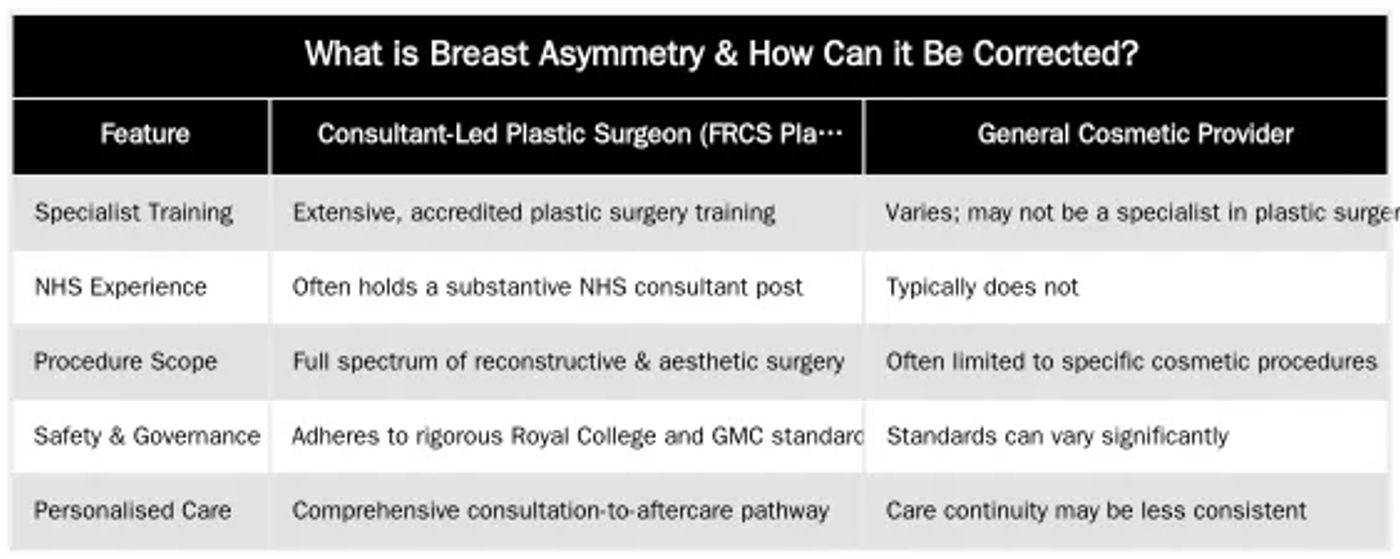
Correcting uneven breasts requires a surgeon with extensive training in both aesthetic and reconstructive plastic surgery. A consultant plastic surgeon on the GMC Specialist Register, like Mr. Roshan Vijayan, has completed rigorous training and holds qualifications like FRCS(Plast), signifying the highest standard of practice. This expertise ensures the surgeon can handle straightforward and complex cases with precision and safety.
Mr. Vijayan's Philosophy: Natural, Balanced, and Safe Outcomes
The goal is to deliver natural, balanced results in harmony with your physique. This philosophy uses safe, tested surgical techniques. Prioritising patient safety and aesthetic balance enhances confidence through results that look and feel authentic. Adherence to the highest professional standards, promoted by organisations like the British Association of Aesthetic Plastic Surgeons (BAAPS), is fundamental.
Understanding the Benefits of a Consultant-Led Practice
Choosing the right surgeon is the most important decision. A consultant-led practice offers care and expertise distinct from general cosmetic providers.
What to Expect: Consultation, Procedure, and Recovery
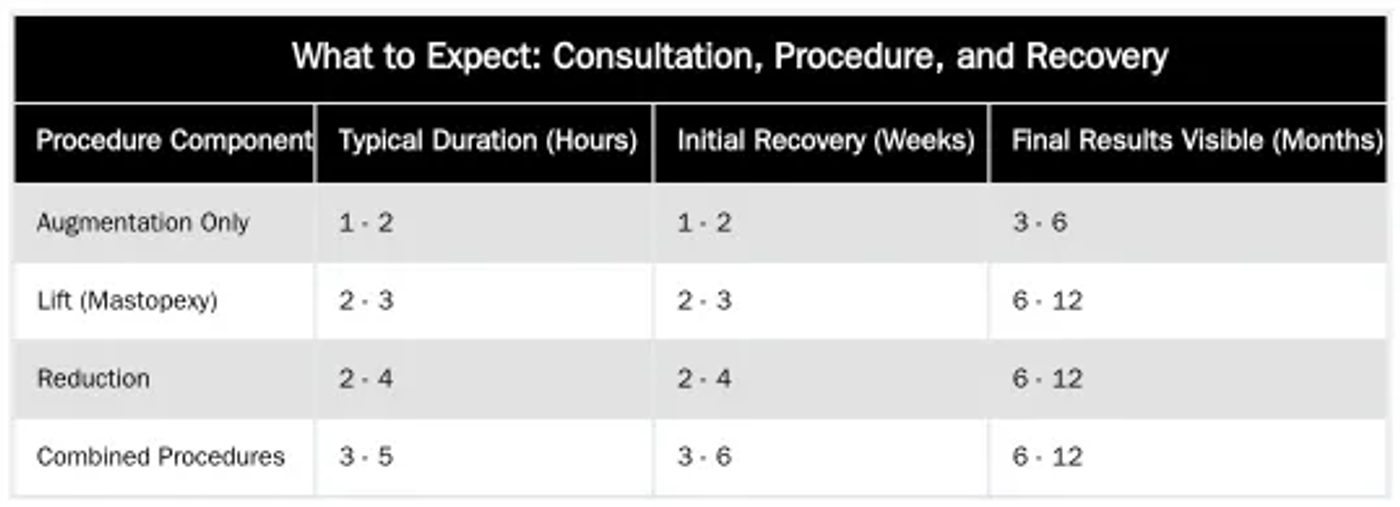
The process begins with a consultation and ends with achieving the desired aesthetic outcome. Understanding each step helps set realistic expectations and prepares you for the procedure.
Your Personalized Consultation and Treatment Plan
During your consultation with Mr. Vijayan, you will discuss your concerns and aesthetic goals. A detailed examination assesses your asymmetry, including measurements of volume, position, and skin quality. This collaborative process develops a bespoke surgical plan. The focus is on achieving symmetrical and natural-looking results with breast surgery that respects your anatomy and aligns with your expectations.
Navigating Recovery and Achieving Your Desired Results
Recovery varies depending on the combination of procedures performed. You will receive detailed aftercare instructions on managing discomfort, caring for incisions, and wearing a supportive surgical bra. Initial results are visible immediately, but it takes several months for swelling to subside and for breasts to settle into their final shape. Adhering to post-operative guidance is crucial for a smooth recovery and optimal outcomes. For general information on surgical recovery, resources like the NHS guide to cosmetic procedures can be helpful.
Ready to Achieve Balanced, Symmetrical Breasts?
If you are considering surgery to correct breast asymmetry, the first step is scheduling a consultation with a qualified expert. A discussion with a consultant plastic surgeon will clarify your options and provide a personalised plan to achieve your aesthetic goals. Mr. Vijayan offers consultations in Hertfordshire and London.
Your Path to Confidence and Symmetry
Correcting breast asymmetry is a personalised procedure combining surgical artistry with technical precision. Choosing a board-certified consultant plastic surgeon ensures your care is guided by expertise, safety, and a commitment to natural-looking results. Whether you need a straightforward augmentation or a complex reconstruction, a tailored approach can help you achieve balanced, symmetrical breasts. To learn more, contact us or Request a Callback to schedule your consultation.
Frequently Asked Questions
What surgical options are used for correcting uneven breasts?
Correcting uneven breasts is highly personalised and often involves a combination of techniques. These may include breast augmentation to add volume, a breast reduction to decrease size, or a breast lift (mastopexy) to adjust position. Mr. Vijayan tailors the approach for each breast individually to achieve a natural and well-proportioned outcome.
How is the best procedure for my breast asymmetry chosen?
The optimal surgical plan is determined during your initial consultation. Mr. Vijayan will conduct a thorough assessment of the differences in breast volume, shape, and nipple position. This evaluation, combined with your personal aesthetic goals, informs the recommendation for the most suitable procedures for your breast asymmetry surgery.
Can surgery fix specific conditions like tuberous breasts?
Yes, surgical correction is highly effective for congenital conditions like tuberous breasts or Poland syndrome. Specialised techniques are used to release constricted tissue, reshape the breast mound, and adjust the areola. The goal is to create a more conventional breast shape and improve overall symmetry.
What does recovery involve after a procedure to correct breast asymmetry?
Recovery varies depending on the complexity of the procedures performed. Patients typically experience some swelling and discomfort for the first few weeks, which is managed effectively. Most individuals can return to light activities within two weeks and resume more strenuous exercise after six weeks, following detailed after-care guidance.
Are the results from breast asymmetry surgery permanent?
The structural corrections made during your breast asymmetry surgery provide a long-lasting improvement in symmetry. While the results are considered permanent, it is important to remember that your breasts can still change over time. Factors such as significant weight fluctuations, pregnancy, and the natural ageing process can alter their size and shape.
How can I find out if I am a suitable candidate for breast asymmetry surgery?
The first step is to schedule a one-on-one consultation with a qualified consultant plastic surgeon like Mr. Vijayan. During this meeting, you can discuss your concerns and he can assess your anatomy to determine if surgery is right for you. To begin your journey, please request a callback to arrange an appointment.