A surgeon's technique is vital for preventing bottoming out, a breast lift complication. This article details causes and surgical strategies for durable internal support, ensuring a natural, long-lasting breast shape. Learn how expert approaches achieve lasting aesthetic outcomes.
Preventing Bottoming Out: Ensuring Durable Breast Lift Outcomes
Preventing bottoming out in breast lifts requires a surgeon's meticulous technique to establish robust internal support, counteracting breast tissue descent. This article explains how mastopexy failure leads to lower pole fullness and the 'pole-in-a-sock' appearance, often necessitating revision mastopexy. It details advanced surgical techniques, including the 'internal bra,' which create a durable internal scaffold stronger than native tissues. Understanding these methods is crucial for achieving natural, long-lasting aesthetic outcomes and avoiding this common breast lift complication.
Mr. Roshan Vijayan, a Consultant Plastic Surgeon, specializes in advanced mastopexy techniques designed to deliver natural, well-proportioned results. His approach prioritizes safe, tried-and-tested methods for durable internal support, minimizing the risk of complications and ensuring patient satisfaction.
To explore your options, contact us to schedule your consultation. You can also reach us via: Request a Callback
A surgeon's technique is the most critical factor in preventing bottoming out, a breast lift complication where tissue descends, compromises the aesthetic result, and may require revision surgery. This article details the causes of this complication and the surgical strategies used to create durable, internal support for a natural, long-lasting breast shape.
What is the 'Bottoming Out' Effect in Breast Lifts?
The 'bottoming out' effect is a mastopexy failure where breast tissue descends after surgery, creating excessive fullness in the lower pole and a nipple-areola complex that appears too high. This outcome negates the goal of a breast lift procedure: to elevate and reshape the breast.
This complication occurs when internal support structures fail to hold repositioned breast tissue against gravity. The result is a "pole-in-a-sock" appearance, where the skin envelope is tight at the top while glandular tissue has fallen to the bottom. This outcome often requires a revision mastopexy.
Why Does Breast Tissue Descend After a Mastopexy? Understanding the Causes
Breast tissue descent after a mastopexy results from a combination of anatomical and physical forces. The primary cause is often a surgical technique that fails to create a durable internal support system for the breast mound. Removing excess skin and tightening the envelope is insufficient for long-term stability.
Without internal reinforcement, glandular tissue—subject to hormonal changes and weight fluctuations—stretches the skin and descends. In an augmentation-mastopexy, implant malposition can also contribute to this effect if the implant drops below the breast fold.
The Role of Tissue Quality and Gravity
Patient tissue quality is a key factor. Skin with poor elasticity and weak connective tissues (fascia) is less capable of supporting the breast's weight. Gravity exerts a constant downward force on the surgical repair. A surgeon must create an internal scaffold stronger than the patient's native tissues to mitigate the risk of a known breast lift complication like tissue descent.
Key Surgical Techniques for Avoiding Tissue Descent: The 'Internal Bra' and Beyond
Modern mastopexy uses internal reinforcement techniques to provide lasting support for breast tissue, counteracting the forces that cause bottoming out. The goal is to build a stable internal platform that maintains the breast's shape and elevation.
The 'Internal Bra' Concept: Creating Lasting Support
The "internal bra" describes several mastopexy techniques that create a supportive sling for breast tissue. It is a surgical construct made from the patient's own tissues, sometimes supplemented with surgical mesh. One method uses deep, permanent or long-lasting sutures to anchor the lower breast gland to the fascia over the chest muscles. This creates a new, reinforced inframammary fold (the crease under the breast) that prevents tissue from descending.
Glandular Reshaping and Skin Envelope Management
Surgeons also reshape the breast gland itself using techniques like auto-augmentation, where the patient's breast tissue is rearranged and secured higher to create upper pole fullness. The skin envelope is then tailored to the new breast shape. The skin must not be closed under excessive tension, which can lead to stretched scars without preventing internal tissue descent.
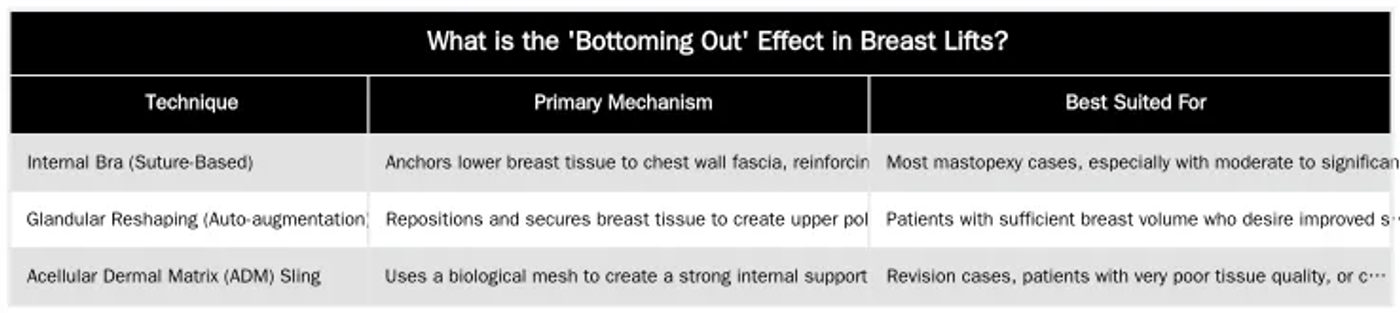
An overview of common surgical strategies used to provide long-term support in breast lift surgery.
Mr. Vijayan's Approach: Ensuring Durable Breast Lift Results
Mr. Roshan Vijayan, a GMC Registered Specialist and Fellow of the Royal College of Surgeons (FRCS(Plast)), uses an evidence-based approach. He applies safe, tested techniques to deliver well-proportioned, balanced, and durable aesthetic outcomes.
Mr. Vijayan's strategy to prevent bottoming out starts with a pre-operative assessment of skin quality, breast volume, and degree of ptosis. This informs a surgical plan tailored to the patient's anatomy, incorporating internal support techniques like a suture-based internal bra and glandular reshaping to ensure durable results.
The Importance of Experience and Meticulous Planning
Mr. Vijayan's specialist training at UK hospitals and his role as an NHS Consultant Plastic Surgeon provide the experience to execute these complex procedures. His planning and execution minimise complication risks, which is fundamental to achieving symmetrical and natural-looking results with breast surgery. His approach re-engineers the breast's internal architecture for longevity, a principle supported by research in publications like the Journal of Plastic and Reconstructive Surgery.
Achieving Lasting Aesthetic Outcomes: What to Expect Post-Surgery
The patient's role during recovery is critical to maintaining the surgical result. Following post-operative instructions is essential to protect internal repairs as they heal. This includes wearing a supportive surgical bra for the prescribed period, typically several weeks, to minimise stress on incisions and internal sutures.
Avoid strenuous activity, heavy lifting, and high-impact exercise for the duration your surgeon recommends. Attend all follow-up appointments to monitor healing. A mastopexy with internal support offers longevity, but breasts are still affected by aging, gravity, and weight fluctuations. If significant descent occurs years later, a revision mastopexy may be an option.
Patient Care and Long-Term Maintenance
Maintaining a stable weight and healthy lifestyle helps preserve results. Continuing to wear a supportive bra, especially during exercise, reduces long-term strain on breast tissue and skin.
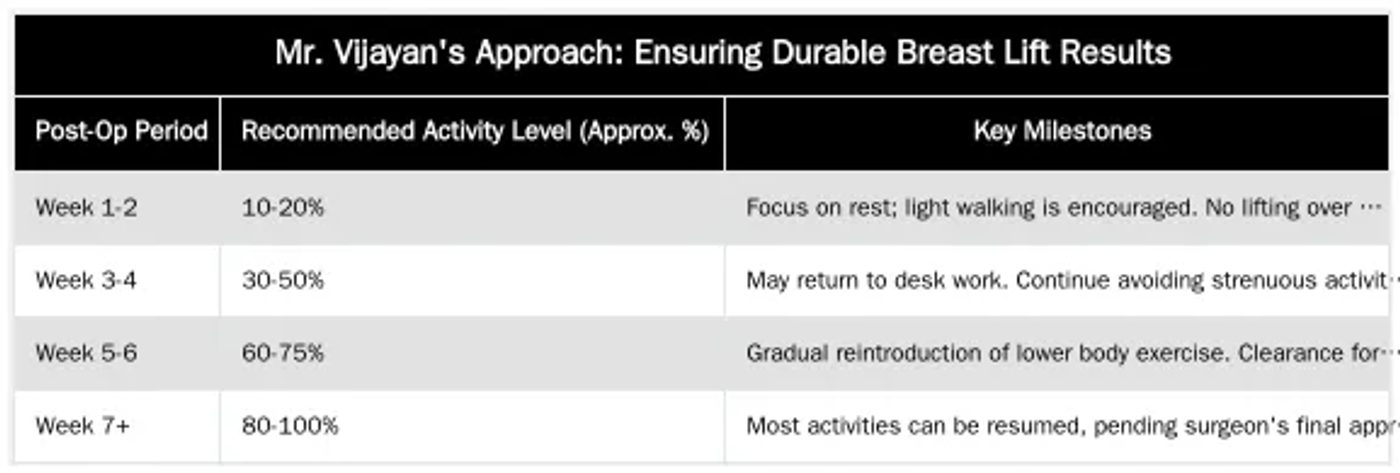
This table provides a general guideline; individual recovery can vary and must be guided by your surgeon's specific instructions.
Considering a Breast Lift? Partner with an Expert for Lasting Results
A breast lift's success and longevity depend on the surgeon's skill and technique. Choosing a board-certified consultant plastic surgeon specializing in mastopexy is the most important step to prevent bottoming out. The ability to create durable internal support distinguishes a temporary fix from a long-term result.
For those considering a breast lift in Hertfordshire or London, a consultation is the best way to understand how these techniques apply to your goals and explore options for safe, durable breast surgery.
Conclusion
Avoiding the 'bottoming out' effect requires precise surgical architecture. Techniques like the internal bra and glandular reshaping create a durable internal structure. This focus on foundational support, combined with post-operative care, is key to a stable, natural, and lasting breast lift result. To discuss your aesthetic goals and Mr. Vijayan's approach, contact us or Request a Callback for a consultation.
Frequently Asked Questions
What is the 'bottoming out' effect after a breast lift?
The 'bottoming out' effect is a potential complication where the breast tissue gradually descends after a mastopexy. This creates excessive fullness in the lower part of the breast and causes the nipple to appear disproportionately high. It indicates that the structural results of the lift have not been maintained over time.
What is the surgeon's primary role in preventing bottoming out?
A surgeon's technique is the most critical factor in preventing bottoming out. An experienced plastic surgeon creates a durable internal support structure, sometimes called an 'internal bra,' using the patient's own tissue or surgical mesh. This internal support secures the breast tissue in its new, elevated position against the long-term forces of gravity.
Are certain patients at higher risk, and how does that affect the strategy for preventing bottoming out?
Yes, patients with heavier breasts, significant skin laxity, or poor skin elasticity are at a higher risk of tissue descent. For these individuals, the surgical strategy for preventing bottoming out is even more crucial. Mr. Vijayan may employ advanced techniques like an auto-dermal sling to provide the robust, long-term support needed to maintain the lift.
Besides an 'internal bra,' what other techniques are important for preventing bottoming out?
Beyond creating internal support, the overall surgical plan and incision placement are vital for preventing bottoming out. A well-executed technique ensures that tension is placed on the stronger, deeper tissues and the chest wall, not just on the skin closure. This provides a more resilient foundation for a lasting, natural-looking result.
Can 'bottoming out' be corrected if it has already occurred?
Yes, this complication can be addressed with a revision mastopexy. During a corrective procedure, the surgeon re-establishes the internal support structures and repositions the descended breast tissue. The goal of the revision is to restore a more youthful, stable, and aesthetically pleasing breast contour.
How can I learn more about Mr. Vijayan's approach to breast lift surgery?
The best way to understand the surgical approach and what results you can expect is through a one-to-one consultation. Mr. Vijayan will assess your individual anatomy and discuss the specific techniques he would use to achieve a durable, natural outcome. You can request a callback to schedule your appointment in Hertfordshire or London.