
This patient's guide to mole cyst lipoma removal covers understanding common skin lesions, when to consider removal, the surgical process, histology, and aftercare. Consultant Plastic Surgeon Mr. Roshan Vijayan provides factual information to help you make informed decisions about surgical excision.
Mole Cyst Lipoma Removal: a Patient's Guide to Safe Excision
Understanding safe mole cyst lipoma removal involves knowing the procedure, specialist care requirements, and achieving optimal aesthetic outcomes. This guide provides factual information for individuals considering surgical excision of common benign skin lesions like moles, epidermoid cysts, and lipomas. It covers the process from initial diagnosis and reasons for removal to the surgical technique, the importance of histology, and comprehensive aftercare, empowering patients to make informed decisions about their dermatological surgery.
Mr. Roshan Vijayan, a Consultant Plastic Surgeon, offers expert guidance on skin lesion excision, ensuring safe procedures and aesthetically pleasing results. His extensive experience in dermatological surgery supports a patient-centric approach to care.
To explore your options, contact us to schedule your consultation. You can also reach us via: Book your skin procedure
A patient's guide to mole cyst lipoma removal requires understanding the procedure, the importance of specialist care, and how to achieve an optimal aesthetic outcome. These common, typically benign skin lesions prompt questions about safety, scarring, and treatment. This article from Consultant Plastic Surgeon Mr. Roshan Vijayan provides factual information for individuals considering surgical excision. It covers the process from diagnosis and reasons for removal to surgical technique and aftercare to help you make an informed decision.
Understanding Common Skin Lesions: Moles, Cysts, and Lipomas
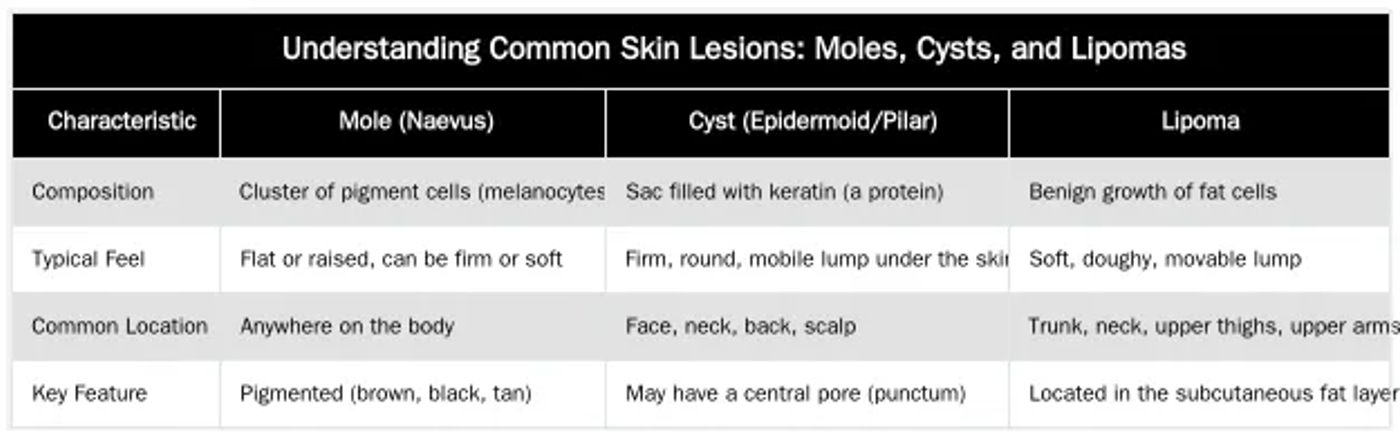
Moles, cysts, and lipomas are distinct skin lesions. Understanding their differences in composition and origin is key to seeking appropriate treatment.
- Moles (Naevi): Common skin growths caused by clusters of pigmented cells (melanocytes). They can be flat or raised, vary in colour, and appear anywhere on the body. While most are harmless, monitoring them for changes is important. More information on mole removal details the process.
- Cysts: Closed sacs beneath the skin containing fluid, pus, or other material. Epidermoid and pilar cysts are common types. They feel like a small, firm pea under the skin and can become inflamed or infected. The goal of cyst removal is to excise the entire sac to prevent recurrence.
- Lipomas: A benign tumour of fatty tissue. They are soft, movable, and painless, located just under the skin. While posing no medical threat, they can grow large, becoming cosmetically bothersome or uncomfortable. The procedure for lipoma removal focuses on complete excision.
Why Choose a Plastic Surgeon for Lesion Removal?
For lesions in visible areas like the face or hands, the surgeon's skill directly impacts the aesthetic result. A consultant plastic surgeon has specialised training to ensure complete, safe removal with the best possible cosmetic outcome. Their understanding of skin anatomy, tension lines, and wound closure methods helps minimise scarring for a natural-looking result. This dual focus on medical efficacy and aesthetics is why patients choose specialist care.
When Should You Consider Removal? Medical vs. Cosmetic Reasons
The decision to remove a benign skin lesion is driven by medical necessity or cosmetic preference. This personal choice is made after a consultation with a specialist to assess the lesion and discuss potential outcomes.
Medical removal is prioritised for lesions causing physical symptoms or clinical concern, including those that are painful, tender, frequently inflamed, or infected. Lumps that catch on clothing or interfere with activities like shaving are also candidates for excision. Any mole showing signs of change requires prompt evaluation.
Cosmetic reasons are equally valid. A lesion in a prominent area like the face, neck, or arms can cause self-consciousness. Removal is performed to improve appearance and boost confidence, emphasizing minimal scarring.
Recognizing Warning Signs: The Importance of Skin Cancer Screening
While most moles are harmless, it is vital to recognize signs of potential malignancy like melanoma. Regular self-examination is a key part of skin health. The "ABCDE" method is a guide for monitoring moles:
- Asymmetry: One half of the mole does not match the other.
- Border: The edges are irregular, ragged, or blurred.
- Colour: The colour is not uniform and may include shades of brown, black, pink, red, or white.
- Diameter: The spot is larger than 6mm across (about the size of a pencil eraser), although melanomas can sometimes be smaller.
- Evolving: The mole is changing in size, shape, or colour.
If you notice any of these changes or a new, unusual spot, seek a professional medical evaluation. The NHS provides comprehensive guidance on when to check your moles.
What to Expect: The Surgical Excision Process Explained
Surgical removal of a mole, cyst, or lipoma is a well-established outpatient procedure. The process is efficient, comfortable, and safe, focusing on complete removal and the final aesthetic result.
The process begins with an initial consultation where Mr. Vijayan will examine the lesion, discuss your goals, and confirm surgical excision is the appropriate treatment. He will explain the procedure, expected outcome, and potential scarring.
On the day of the procedure, the area is cleaned and marked. A local anaesthetic is administered to numb the site, making the process pain-free. Once numb, the surgeon excises the lesion. For moles, a small margin of healthy tissue is often removed to ensure all atypical cells are gone. For cysts, the entire sac wall is dissected out to prevent recurrence. For lipomas, the fatty lump is removed through an incision.
Local Anaesthesia and Minimally Invasive Techniques
Local anaesthesia enables safe and comfortable skin lesion removal. It involves injecting a numbing agent around the lesion. A small initial sting is followed by rapid numbing of the area, allowing the procedure to be performed without pain while you are awake.
Minimally invasive techniques are prioritised. Incisions are planned within natural skin creases (Langer's lines) to conceal the scar. The incision size is the minimum required for complete and safe removal. This planning is fundamental to achieving a good cosmetic outcome.
Beyond Removal: The Role of Histology and Aesthetic Outcomes
Successful skin lesion removal requires ensuring it is medically benign and achieving a cosmetically pleasing result. A consultant plastic surgeon's approach addresses both elements.
After excision, every lesion is sent for histological analysis, a standard part of care. A pathologist examines the tissue under a microscope to confirm the diagnosis (e.g., that a mole is benign or a lump is a lipoma). Histology also confirms complete removal by checking the "margins" (the edges of the excised tissue). This process provides peace of mind for the patient and surgeon.
This clinical rigour is a hallmark of care from surgeons who are Fellows of the Royal College of Surgeons (FRCS), a qualification signifying extensive training and adherence to high standards of surgical practice.
Achieving Optimal Aesthetic Outcomes with Expert Closure
The skill of the wound closure largely determines the final scar's appearance. A plastic surgeon uses specialised techniques to minimise skin tension and promote fine-line healing. This involves using multiple suture layers. Deep, dissolvable stitches bring underlying tissues together, taking tension off the surface skin. The skin is then closed with fine, non-dissolvable stitches placed to align the edges perfectly.
This tension-free closure is crucial for creating a scar that is flat, thin, and less noticeable over time. For patients with existing wide or raised scars, procedures like scar revision surgery can improve their appearance.
Life After Removal: Aftercare, Recovery, and Long-Term Results
Proper aftercare is essential for a smooth recovery and the best long-term result. Following your surgeon's instructions minimises the risk of complications like infection and supports wound healing. Recovery is typically straightforward, with most patients resuming normal daily activities quickly.
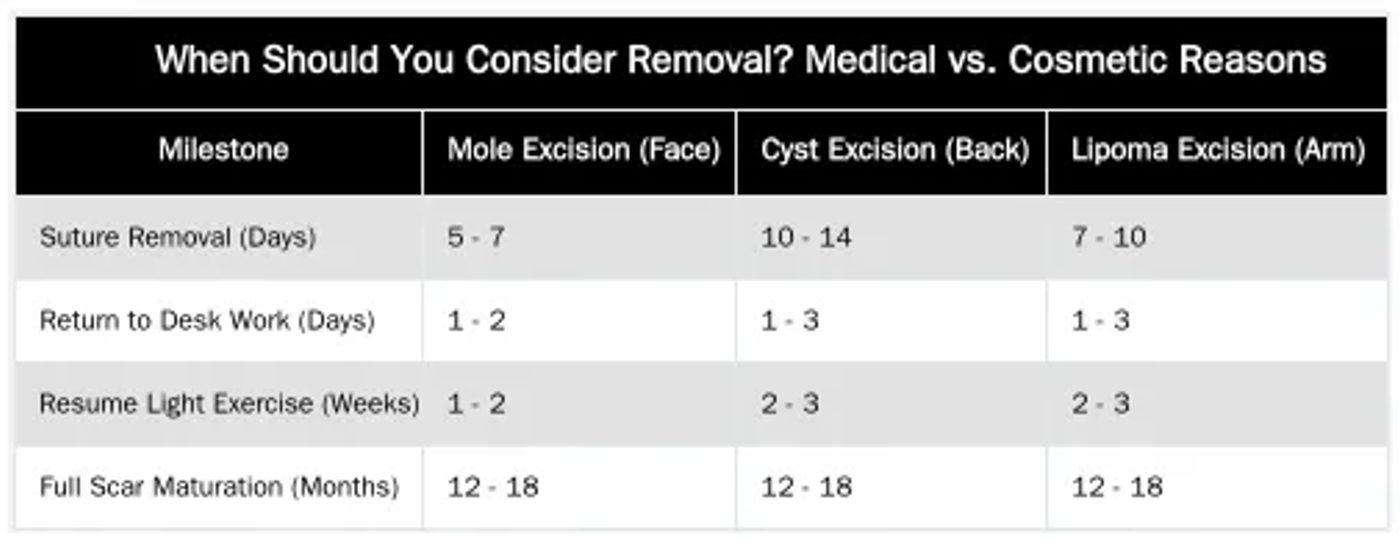
After the procedure, a sterile dressing is applied. You will receive instructions on wound care, including when to get it wet and how to clean it. Stitches are usually removed 5 to 14 days later, depending on the location and suture type. During initial healing, avoid activities that could stretch the wound.
Comprehensive Aftercare for a Smooth Recovery
A consultant-led approach ensures aftercare and follow-up until you are fully healed. You will be advised on managing mild discomfort, which is typically controlled with over-the-counter pain relief. A new scar is initially pink or red; this is a normal part of healing. Over 12 to 18 months, the scar will fade, soften, and become less noticeable. Protecting the new scar from sun exposure for at least the first year is critical to prevent it from darkening.
Your Trusted Partner for Safe and Aesthetic Skin Lesion Removal
Choosing the right surgeon is the most important step. Mr. Roshan Vijayan is a GMC-registered, board-certified Consultant Plastic Surgeon with extensive NHS and private practice experience across London and Hertfordshire. His qualifications, including a Fellowship of the Royal College of Surgeons (FRCS Plast), reflect the highest standards of patient safety and surgical excellence.
Mr. Vijayan's patient-centric philosophy uses a partnership approach, ensuring you feel informed, comfortable, and confident. He combines proven surgical techniques with a focus on natural, well-proportioned aesthetic outcomes. To begin your consultation, Book your skin procedure.
Conclusion
Effective and safe removal of moles, cysts, and lipomas balances medical necessity with aesthetic precision. Understanding your lesion, the reasons for removal, and the surgical process empowers you to seek the best care. A consultant plastic surgeon has the skill to remove the lesion completely while minimising scarring and optimising the final appearance. This dual focus ensures clinical safety and patient satisfaction. If you are considering skin lesion removal in Hertfordshire or London, contact us to schedule a consultation. You can also Book your skin procedure directly.
Frequently Asked Questions
Why should I choose a plastic surgeon for mole cyst lipoma removal?
A consultant plastic surgeon has specialised training in techniques that ensure the complete excision of the lesion while prioritising the best aesthetic result. This expertise is crucial for minimising scarring, especially in visible areas like the face. The focus is on both medical safety and a cosmetically pleasing outcome from your mole cyst lipoma removal.
What is the typical process for mole cyst lipoma removal?
The process begins with a thorough consultation to assess the lesion and discuss your goals. The removal is a minor surgical procedure performed under local anaesthetic, meaning you are awake but the area is numb. After excision, the tissue is always sent for histological analysis to confirm its nature, ensuring your peace of mind.
Will I have a noticeable scar after mole cyst lipoma removal?
While any surgical excision creates a scar, a plastic surgeon uses precise techniques to make it as inconspicuous as possible. Incisions are often placed within natural skin lines or creases to help hide them. The goal of professional mole cyst lipoma removal is to leave a fine, faint line that fades significantly over time.
What does recovery involve after the excision of a skin lesion?
Aftercare is generally straightforward and focuses on promoting optimal healing. You will receive detailed instructions from Mr. Vijayan on how to care for the small wound, which typically involves keeping it clean and dry. Following these guidelines is essential for achieving the best result from your mole cyst lipoma removal.
When should I consider having a mole, cyst, or lipoma removed?
You should seek a consultation if a lesion changes in size, shape, or colour, or if it becomes painful, inflamed, or infected. Removal is also a common choice for cosmetic reasons if a benign growth affects your confidence or is in an inconvenient location. A professional assessment is the best way to determine the right course of action.
How can I book a consultation to discuss my skin lesion removal?
The first step is to schedule a professional consultation with Mr. Roshan Vijayan to assess your specific needs. You can discuss your concerns, evaluate the lesion, and receive a personalised treatment plan. To arrange your appointment in Hertfordshire or London, please book your consultation here.