
The internal bra technique is a mastopexy surgery method that provides durable, internal support to breast tissue, improving the longevity of a breast lift. It addresses long-term sagging and loss of shape by creating an internal scaffold that reinforces the breast's structure.
Internal Bra Technique: Enhancing Breast Lift Longevity
The internal bra technique in mastopexy creates a durable internal support system for breast tissue, significantly enhancing breast lift longevity. This advanced method involves placing biocompatible materials like surgical mesh or acellular dermal matrix (ADM) to form an internal scaffold. This scaffold provides robust breast tissue support, preventing common issues like 'bottoming out' and maintaining the lifted shape over time. It reinforces the breast's structure, distributing weight and reducing strain on skin and sutures, leading to more stable and long-lasting breast lift results compared to traditional approaches.
Mr. Roshan Vijayan, a Consultant Plastic Surgeon, offers expert insights into advanced mastopexy techniques. His practice focuses on safe, tried, and tested surgical methods to achieve natural, well-proportioned aesthetic outcomes, ensuring patient trust and long-term satisfaction.
To explore your options, contact us to schedule your consultation. You can also reach us via: Request a Callback
The internal bra technique is a mastopexy surgery method that provides durable, internal support to breast tissue, improving the longevity of a breast lift. It addresses long-term sagging and loss of shape by creating an internal scaffold that reinforces the breast's structure.
What is the Internal Bra Technique in Mastopexy?
The internal bra technique is a surgical method used in a mastopexy, or breast lift, to create a supportive internal structure for breast tissue. It involves placing a biocompatible material, such as surgical mesh or an acellular dermal matrix (ADM), as a scaffold. The scaffold holds the lifted breast tissue in its elevated position, providing reinforcement beyond what skin and sutures alone can offer.
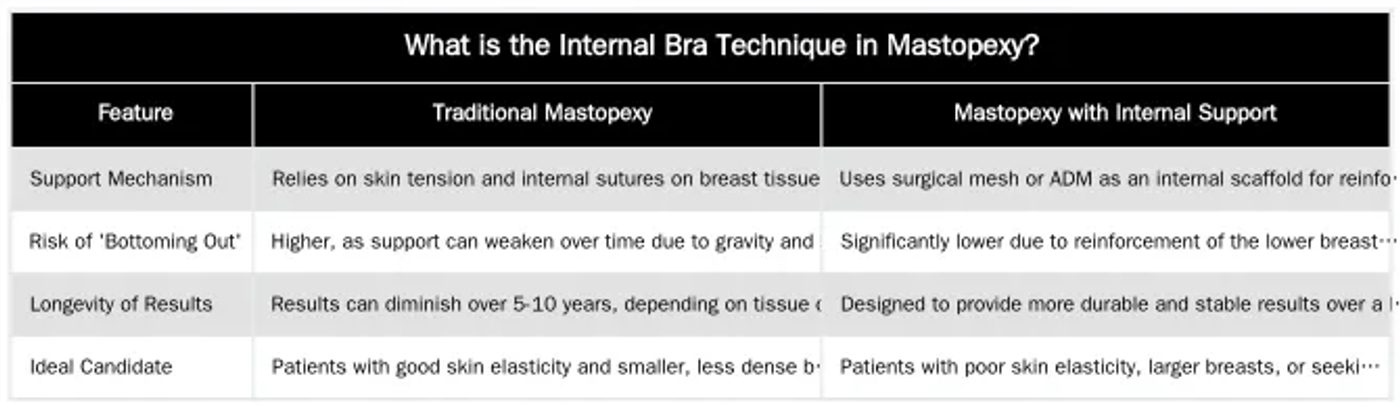
Unlike a traditional breast lift, which relies on reshaping existing tissue and skin, this method adds structural integrity. It counteracts the effects of gravity, skin stretching, and tissue weight over time. Reinforcing key areas, particularly the lower breast pole and the inframammary fold (the crease beneath the breast), enhances the durability and stability of the surgical outcome for more predictable, long-lasting results.
How Does This Technique Enhance Breast Lift Longevity?
This method enhances breast lift longevity with a durable internal support system. The implanted mesh or ADM integrates with the patient's tissue, creating a reinforced layer that distributes breast weight. This reduces strain on the skin and internal sutures, the primary points of failure in a traditional lift.
Structural reinforcement maintains the surgery's aesthetic results by preserving upper pole fullness, defining the breast crease, and maintaining projection. The breast shape remains stable and resists descent from ageing and gravity.
Preventing 'Bottoming Out' and Sustaining Lift
'Bottoming out' describes the gradual descent of breast tissue, and sometimes an implant, below the inframammary fold after a breast lift, causing a loss of the lifted appearance. The internal support structure counteracts this by creating a 'sling' or hammock at the base of the breast, preventing tissue from migrating downwards and sustaining the lift.
Traditional vs. Internal Bra Mastopexy: A Longevity Comparison
The following table compares longevity and support between traditional and internal bra mastopexy techniques.
Choosing the Right Support: Materials and Candidacy
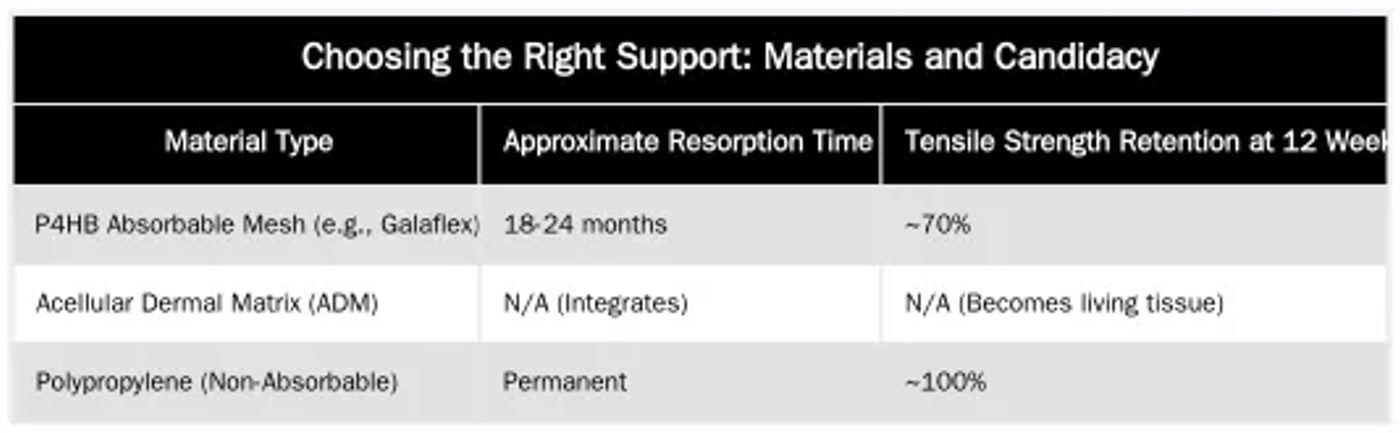
Material selection for the internal support structure depends on the patient's anatomy, tissue quality, and surgical goals. The two primary material categories are surgical mesh and acellular dermal matrix (ADM), each with properties that influence the breast lift's outcome and longevity.
Understanding Surgical Mesh and Acellular Dermal Matrix
Surgical meshes are synthetic or biologic. Synthetic meshes, like Galaflex, are made from poly-4-hydroxybutyrate (P4HB), a biocompatible, absorbable polymer. Over 18-24 months, this mesh dissolves while stimulating the body to produce a strong, organized collagen layer in its place, providing durable support. Non-absorbable synthetic meshes offer permanent reinforcement. Acellular Dermal Matrix (ADM) is a biologic material from donated tissue processed to remove cells, leaving a collagen scaffold. ADM integrates into the patient's body, becoming living tissue and providing natural-feeling support. The choice between materials is key when planning for different mastopexy techniques.
Who is an Ideal Candidate for Enhanced Breast Support?
Ideal candidates for this technique often include:
- Patients with significant breast ptosis (sagging) and poor skin elasticity.
- Individuals with large or heavy breasts, where the tissue weight places greater strain on the lift.
- Patients undergoing a mastopexy with implants, as the internal support can help stabilize the implant and prevent malposition.
- Those seeking the most durable, long-term results and wishing to minimize the risk of recurrent sagging.
A consultation determines if the internal bra technique is the most appropriate approach for a patient's aesthetic objectives.
Expert Insights: Mr. Vijayan's Approach to Advanced Mastopexy
Mr. Roshan Vijayan is a board-certified Consultant Plastic Surgeon whose practice focuses on natural, balanced aesthetic outcomes. This philosophy guides his application of mastopexy procedures to create enduring results.
Mr. Vijayan assesses each patient's anatomy and tissue characteristics to select the appropriate surgical method and support material for long-lasting breast tissue support. He applies techniques to enhance shape and stability while maintaining a natural feel.
Prioritizing Safety and Natural Outcomes in Breast Lift Surgery
Patient safety is the priority. Using biocompatible materials like ADM and absorbable meshes aligns with Mr. Vijayan's commitment to safe surgical techniques. Research in the Aesthetic Surgery Journal documents the safety profile of these materials in breast surgery when used by qualified surgeons. Choosing a Fellow of the Royal College of Surgeons (FRCS Plast) ensures the surgeon has met high standards for training and expertise in plastic surgery.
Personalized Planning for Optimal Breast Tissue Support
Mr. Vijayan develops a personalized surgical plan for each patient. The plan considers breast volume, skin quality, degree of sagging, and the patient's lifestyle and long-term goals. Tailoring the internal support method to individual needs ensures an aesthetically pleasing and structurally sound result.
What to Expect: Results, Recovery, and Long-Term Stability
A mastopexy with an internal support structure provides a more stable and durable outcome. Recovery is similar to a traditional breast lift, but the internal support provides immediate reinforcement, maintaining the new breast contour during healing.
Initial recovery involves wearing a supportive surgical garment, managing swelling, and adhering to activity restrictions for several weeks. As the body heals, the internal mesh or ADM integrates with surrounding tissue, becoming an unnoticeable part of the breast's structure. Most patients report the breast feels natural once healing is complete.
Achieving Enduring Breast Lift Results and Stability
The primary aesthetic benefit is enhanced longevity. The breasts maintain their elevated position, shape, and upper-pole fullness longer than with traditional methods. This stability reduces the risk of recurrent sagging. Learn more about what to expect from long-term breast lift results and their maintenance.
Post-Operative Care and Living with an Internal Bra
Long-term care involves maintaining a stable weight and a healthy lifestyle, as weight fluctuations can affect surgical results. The internal support does not interfere with daily activities, exercise, or future mammograms, although patients should inform their radiologist of their surgical history. The material is not palpable or visible, ensuring a natural look and feel. The support preserves the surgical outcome long-term.
Considering an Internal Bra Mastopexy? Take the Next Step
An internal support structure can enhance the longevity and stability of your breast lift outcome. If you are in Hertfordshire or London and want to learn how this technique can help you achieve your aesthetic goals, the next step is a personal consultation.
A consultation with a specialist plastic surgeon will determine if this procedure is right for you. To explore your options with Mr. Roshan Vijayan, Request a Callback to schedule your appointment.
Conclusion
The internal bra technique enhances the durability of mastopexy results. By providing an internal scaffold to support breast tissue, this method combats gravity and time, preventing issues like 'bottoming out' and recurrent sagging. This technique is an option for patients seeking a stable, long-lasting, and natural-looking outcome. To learn if you are a candidate, contact us for a consultation. You can also Request a Callback.
Frequently Asked Questions
What is the internal bra technique in mastopexy?
The internal bra technique is an advanced surgical method used during a breast lift (mastopexy) to create a durable support structure for the breast tissue. A surgeon places a biocompatible material, typically a surgical mesh, inside the lower part of the breast to act as a scaffold. This internal reinforcement helps hold the newly lifted tissue in its elevated position for a longer-lasting result.
How does the internal bra technique improve breast lift longevity?
This surgical approach enhances longevity by providing robust internal support that counteracts the effects of gravity and skin stretching over time. The internal scaffold significantly reduces the risk of recurrent sagging or the "bottoming out" effect that can occur after a traditional lift. As a result, the aesthetic improvements from a mastopexy using an internal bra method are preserved for many more years.
Who is an ideal candidate for a breast lift with the internal bra technique?
The internal bra technique is particularly beneficial for patients with poor skin elasticity, heavier breast tissue, or those seeking the most durable outcome from their breast lift. It is also an excellent option for individuals who have experienced significant breast changes after pregnancy or weight loss. A specialist surgeon can assess your tissue quality and goals to determine if this is the right approach for you.
Is the mesh used for internal breast support permanent?
Not always. Many modern procedures use a resorbable mesh that the body safely absorbs over 18 to 24 months. As the mesh dissolves, it stimulates the body to produce a new, strong layer of natural collagen tissue. This new tissue then takes over, providing lasting internal support long after the original mesh is gone.
Does this advanced mastopexy technique increase recovery time?
Incorporating an internal support structure does not significantly alter the standard recovery timeline for a mastopexy. Patients follow the same post-operative care instructions, including wearing a support garment and avoiding strenuous activity. The overall healing process is generally comparable to that of a traditional breast lift.
How can I find out if the internal bra technique is right for me?
The best way to determine if this advanced mastopexy is suitable for your specific anatomy and aesthetic goals is to schedule a personal consultation. Mr. Roshan Vijayan will conduct a thorough assessment and discuss the most effective surgical plan to achieve natural, long-lasting results. You can request a callback to arrange your appointment and take the next step.