
Understanding breast lift suture methods is essential for optimal healing and minimal scarring after a mastopexy. This article compares dissolvable versus permanent stitches, their properties, and impact on recovery. Learn how clinical factors guide a surgeon's selection for the best results.
Breast Lift Suture Methods: Optimizing Healing and Scar Minimization
Breast lift suture methods are crucial for achieving optimal healing and minimal scarring after a mastopexy. This article details the distinctions between dissolvable stitches and permanent sutures, examining their properties, impact on wound healing, and role in scar minimization. Understanding these breast lift suture methods empowers patients to comprehend how surgical closure techniques influence recovery and long-term aesthetic outcomes. Expert surgeons carefully select absorbable sutures for deeper tissue support and non-absorbable sutures for durable internal anchoring, tailoring choices to individual patient needs and desired results.
Mr. Roshan Vijayan, a Consultant Plastic Surgeon, applies tried and tested surgical techniques to ensure natural, well-proportioned aesthetic outcomes. His expertise in breast lift procedures prioritizes patient safety and effective healing through meticulous surgical closure.
To explore your options, contact us to schedule your consultation. You can also reach us via: Request a Callback
Understanding breast lift suture methods is essential for optimal healing and minimal scarring after a mastopexy. This article compares dissolvable versus permanent stitches, their properties, impact on recovery, and the clinical factors that guide a surgeon's selection.
What Are Breast Lift Suture Methods?
Breast lift surgical closure uses sutures (specialized threads) to close incisions, support repositioned breast tissue, and secure the new breast contour. A combination of suture types is typical: stronger, long-lasting sutures support deeper layers, while fine stitches close the skin to minimize scarring. The primary categories are dissolvable (absorbable) and permanent (non-absorbable) sutures.
Suture selection and placement are critical. They support tissues during healing, maintain the lifted shape, and reduce tension on skin incisions.
The Role of Surgical Closure in Mastopexy
In a mastopexy or breast lift procedure, surgical closure is a multi-layered process that rebuilds the breast's internal structure. Deeper sutures anchor breast tissue to a higher position on the chest wall, creating foundational support for the lift. Superficial sutures precisely bring skin edges together, which is vital for secure healing and final scar appearance.
Dissolvable vs. Permanent Stitches: Key Differences
The choice between absorbable and non-absorbable sutures depends on the surgical goal for each tissue layer. Each type has distinct properties, materials, and functions.
Absorbable Sutures for Breast Lifts
Absorbable (dissolvable) sutures are made from materials the body breaks down and absorbs over time via hydrolysis. This eliminates the need for stitch removal, enhancing patient convenience. They are used for closing deeper tissue layers and for subcuticular skin closure, where the stitch is placed just beneath the skin surface to leave a fine scar line.
Non-Absorbable Sutures in Plastic Surgery
Non-absorbable (permanent) sutures are made from materials the body cannot break down, such as nylon or polypropylene. They are chosen when long-term or permanent tissue support is required. In a breast lift, they can be used internally to provide durable support to the new breast mound. If used on the skin's surface, they must be manually removed by the surgeon once the incision has healed.
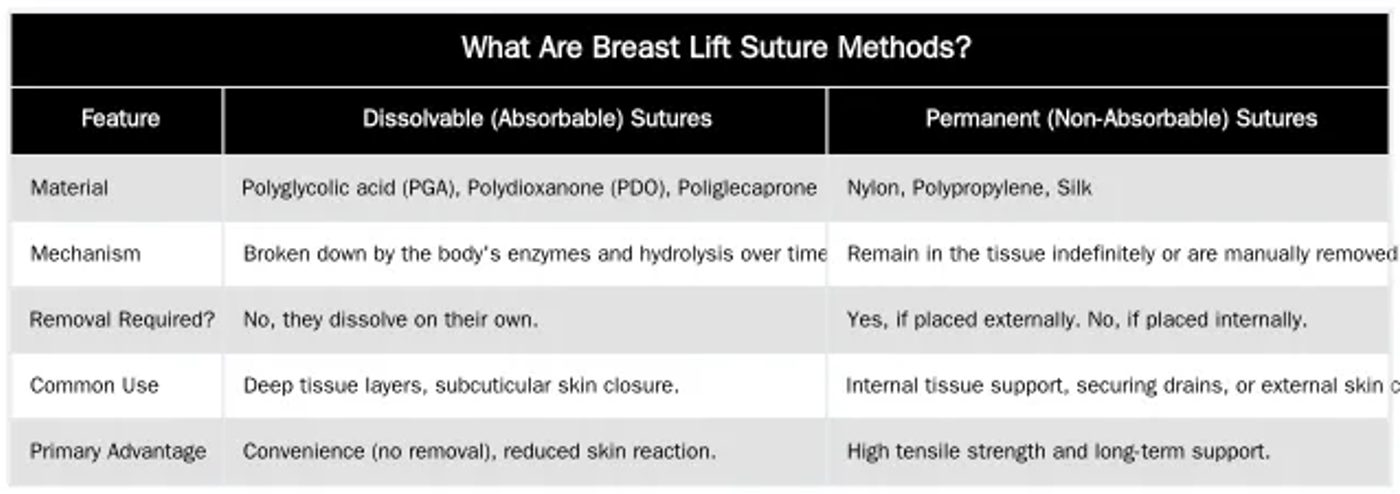
Comparison of characteristics and applications of dissolvable and permanent sutures in breast lift surgery.
How Suture Choices Influence Healing & Scar Minimization
Suture material and closure technique directly influence wound healing and final scar quality. A surgeon's goal is to support tissue repair while minimizing inflammation and tension, key factors in scar formation.
Wound Healing and Suture Placement
Proper wound healing requires bringing tissue edges together accurately without excessive tension. Sutures that are too tight can restrict blood flow and damage tissue, while sutures that are too loose may not provide adequate support, leading to wound separation. A multi-layered closure technique allows the surgeon to distribute tension across deeper, stronger tissues. This reduces strain on the skin layer, which is crucial for preventing scar widening and promoting a healthier healing response.
Suture Methods for Scar Minimization
For skin closure, surgeons often prefer fine, absorbable sutures placed in a subcuticular fashion (below the skin surface). This technique avoids the "railroad track" marks left by traditional interrupted stitches. Eliminating removal also avoids disrupting healing skin. This approach helps minimize breast lift scars and reduces the risk of keloid scarring in predisposed individuals.
The Surgeon's Perspective: Selecting Suture Methods
Suture material and technique selection is a nuanced decision tailored to each patient's anatomy and surgical goals, based on an understanding of tissue dynamics and wound healing principles.
Patient Factors and Tissue Quality
Patient-specific factors guide suture choice, including skin elasticity, breast tissue density, degree of sagging, and healing history. A patient with heavier breast tissue may require stronger, longer-lasting internal sutures to support the lift. A patient with delicate skin may benefit from finer, less reactive materials.
Safe and Tested Surgical Techniques
Patient safety and predictable outcomes guide surgical decisions, including using safe and tested techniques for surgical closure. Suture choice is informed by clinical evidence on material properties like tensile strength and absorption profiles, detailed in resources like the National Center for Biotechnology Information (NCBI).
Recovery: What to Expect with Different Suture Types
The suture type used in your mastopexy affects post-operative care and recovery. Following your surgeon's aftercare instructions is paramount.
Dissolvable Stitches: Dissolution Timelines and Care
Dissolvable stitches do not need to be removed, as the body gradually breaks them down. Suture ends may become visible at the incision line before falling off; this is normal. Do not pull at them. Keep the incision area clean and dry as instructed. The absorption timeline varies by material but is generally predictable.
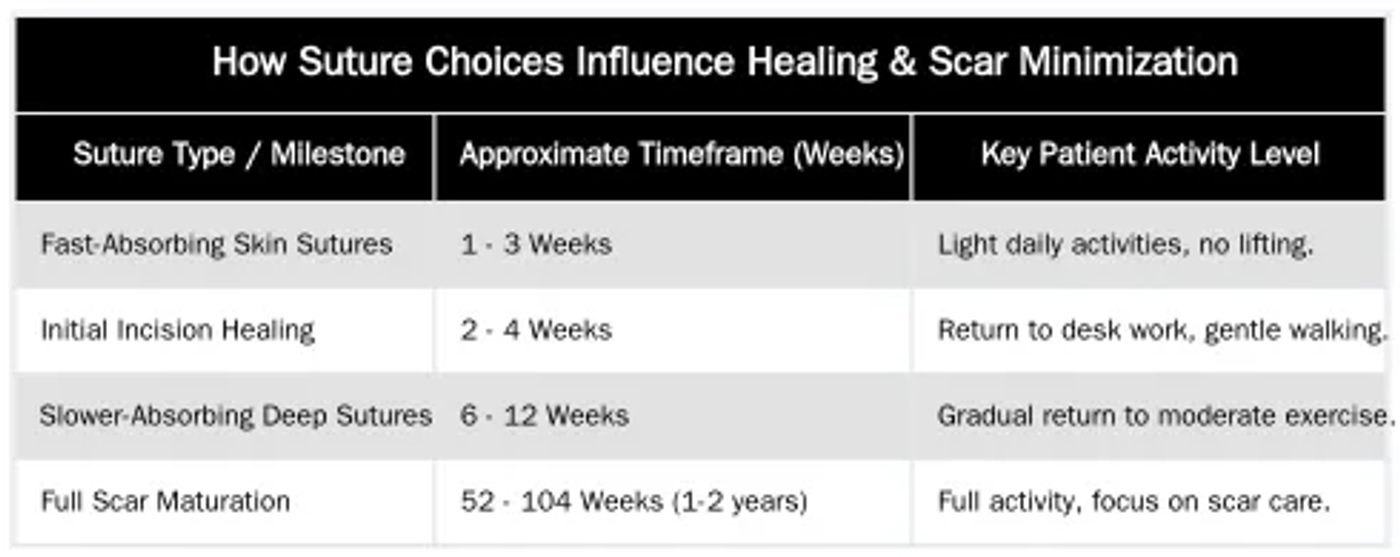
Estimated timeline for suture dissolution and recovery milestones after a breast lift.
Permanent Sutures: Removal and Long-Term Considerations
If non-absorbable sutures are used for skin closure, they are removed in a follow-up appointment, typically 7 to 14 days after surgery. Internal permanent sutures remain in the body for lasting support and require no specific long-term care. The mastopexy recovery timeline provides further details.
Breast Lift Results and Surgical Care
The final aesthetic outcome of a breast lift results from surgical planning and execution. Suture material and closure technique are critical details. Tailoring the approach to each patient's tissue and goals helps create a supportive internal structure and a fine scar.
This attention to detail is fundamental to achieving natural, balanced results and a safe recovery.
Conclusion
Selecting the right breast lift suture method is a cornerstone of a successful mastopexy, influencing healing, comfort, and final aesthetic appearance. A surgeon's expertise in choosing between dissolvable and permanent stitches for different tissue layers is key to minimizing scarring and ensuring durable, natural-looking results. If you are considering a breast lift in Hertfordshire or London, contact us to discuss your options. For a personal consultation, Request a Callback.
Frequently Asked Questions
What types of sutures are used in modern breast lift suture methods?
Modern breast lift suture methods typically involve a multi-layered approach for optimal support and aesthetics. Deeper layers of breast tissue are often secured with stronger, long-lasting absorbable sutures to maintain the new contour. The skin is then meticulously closed with very fine dissolvable stitches to minimise scarring and eliminate the need for a removal appointment.
How do different breast lift suture methods affect scarring?
The choice of stitching technique significantly influences the final appearance of scars. Advanced breast lift suture methods prioritise placing dissolvable stitches beneath the skin's surface, which avoids the "track marks" that can be left by external stitches. This meticulous closure reduces tension on the skin, promoting the formation of a thin, flat, and less noticeable scar over time.
Are permanent stitches ever used in breast lift suture methods?
While less common for skin closure, permanent sutures can play a specific role in some breast lift suture methods. They may be used internally in deep tissue layers to provide durable, long-term structural support, helping to maintain the lift's shape for years to come. However, for the visible skin incisions, absorbable sutures are almost always preferred for the best cosmetic result.
How does the choice of stitching technique impact recovery after a mastopexy?
The suture technique directly impacts the recovery experience. Using dissolvable stitches for the skin closure is more convenient as it eliminates the need for a suture removal appointment. Proper internal suturing also provides essential support during the initial healing phase, reducing strain on the external incisions as you move and heal.
Is it possible to have an allergic reaction to breast lift sutures?
While true allergies to modern surgical sutures are very rare, mild inflammatory reactions can occasionally occur. Mr. Vijayan minimises this risk by using high-quality, biocompatible materials that are well-tolerated by the vast majority of patients. Any concerns about potential material sensitivities are always discussed thoroughly during your pre-operative consultation.
How can I learn which breast lift suture methods are right for my procedure?
The best way to determine which breast lift suture methods will achieve your desired outcome is through a personal consultation. Mr. Vijayan will assess your individual anatomy and aesthetic goals to recommend a tailored surgical plan. To begin this conversation, you can request a callback to schedule your appointment.